


Executive Summary
In this document, Power Dynamics Innovations (PDI) outlines the concept and benefits of using a pipe tensioner to push the product pipe while a horizontal directional drilling (HDD) rig pulls it during product pullback. In a conventional HDD setup, the rig must generate all the force required to overcome pipe-soil friction, bends in the bore path, buoyancy effects, and the weight of the pipe string. By adding a pipe tensioner on the entrance end, forward thrust is applied directly to the product pipe, reducing the net load seen by the rig.
The result is a safer, more controlled, and more efficient installation. The push-assist provided by the tensioner helps protect the HDD rig from overload conditions, improves operator control of pipe movement, and reduces the risk of damage to the product pipe and its coating. This approach is especially valuable for longer bores, larger-diameter pipe, and challenging ground conditions where pullback loads can approach or exceed the safe capacity of the rig.
In summary, combining a pipe tensioner with an HDD rig during pullback distributes the mechanical load between two systems instead of one, helping to:
• Protect the rig by lowering peak pullback loads and shock events.
• Improve safety by stabilizing the installation and anchoring system.
• Protect the pipe by minimizing dragging, coating damage, and bending stresses.
• Increase efficiency and reliability on demanding HDD projects.
1. Pipe Tensioner Specifications
PDI is a specialist in the design and fabrication of high-performance pipe-tensioning equipment. The unit described below represents the specifications for a 100-kip pipe tensioner currently under construction by PDI to be added to our rental fleet or available for direct purchase. The respective HPU is containerized and available for rental. These specifications provide a reference for capabilities, integration requirements, and expected operating ranges for this machine.
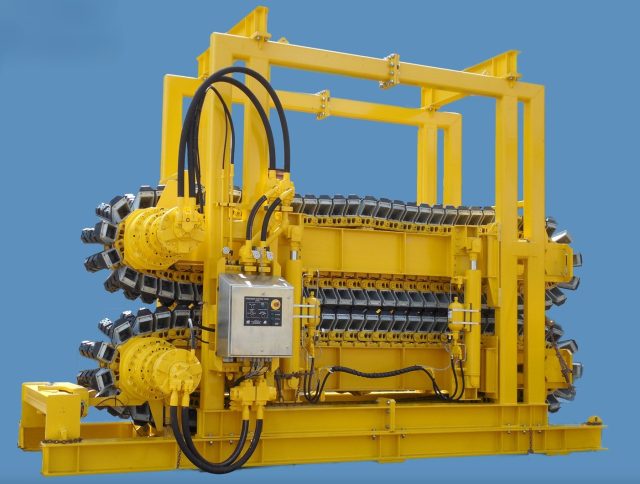
| Design Type: Vertical Enclosed | Maximum Clamp: 200,000 lbs. |
| Maximum Linear Tension: 100,000 lbs. | Maximum Clamp per Foot: 16,000 lbs. per foot |
| Maximum Speed: 48 fpm | Pipe B.O.P.: 56 15/16 inches |
| Number of Tracks: 2 | Controls: Electronic Digital |
| Pipe Size Range: 4 – 48 inches (48 inches includes coating) | Operation Weight: 55,090 lbs. |
| Nominal Tensioner Opening: 56 inches wide x 56 inches high | Height: 173 9/16 inches (14 feet-5 9/16 inches) |
| Pipe Contact Length: 150 inches | Width: 103 ¼ inches (8 feet-7 ¼ inches) |
| Length: 245 7/16 inches (20 feet -5 7/16inches) |
2. Concept of Push-Assist During HDD Pullback
In a standard HDD installation, the drill rig performs all of the work of pulling the product pipe through the reamed bore. The rig must overcome friction along the entire pipe length, resistance at bends, and the weight and buoyancy effects of the pipe. As bore length and pipe diameter increase, the required pullback force can climb rapidly, approaching the limits of the rig and anchoring system.
A pipe tensioner changes this load-sharing picture by applying forward thrust directly to the pipe string from the entrance end. The HDD rig still provides the primary pulling force and maintains control of the drill string, but the tensioner assists by pushing the pipe into the bore. This reduces the net load that the rig must generate, often by a significant margin.
Mechanically, the system can be thought of as a push–pull pair: the rig pulls on the pipe at the downhole connection while the tensioner pushes from the surface near the entry location. As long as the pipe tensioner and HDD rig are properly synchronized, the pipe moves smoothly through the bore, and overall forces in the system are more evenly distributed.
Throughout the operation, load readings from the rig and from the pipe tensioner, are used to keep forces within safe limits and to react to changes such as tight spots, increased friction, or unexpected obstructions.
3. Detailed Benefits of Using a Pipe Tensioner
3.1 Protection of the HDD Rig
By providing forward thrust on the product pipe, the tensioner directly reduces the pullback load that the HDD rig must generate. This has several important effects:
• Lower average pullback loads on the drill string, rotary head, and thrust frame.
• Reduced peak loads caused by friction spikes, bends, or transitions in soil conditions.
• Less stress on the rig’s anchoring system, decreasing the risk of movement or failure.
Over time, these reductions in mechanical stress can extend rig life, cut down on unplanned maintenance, and reduce the likelihood of catastrophic failures such as rod breakage or structural damage to the rig frame.
3.2 Safety Improvements
High pullback loads and sudden load spikes can create safety risks for personnel and equipment. A pipe tensioner helps mitigate these risks by sharing the overall load and smoothing out pipe movement. Key safety benefits include:
• Reduced chance of rig anchoring failure or movement under high load.
• Lower risk of sudden shock loading if a tight spot in the bore is passed or an obstruction is cleared.
• More stable operating conditions, which make it easier for operators to anticipate and manage changes.
Combined with proper procedures and communication, the use of a pipe tensioner contributes to a safer work environment around the rig and pipe string.
3.3 Protection of the Product Pipe
Without a tensioner, the product pipe is more likely to be dragged across supports and ground surfaces as the rig pulls. This can increase coating damage, surface wear, and bending stresses, especially near the entry point. The tensioner helps by:
• Actively feeding the pipe forward instead of allowing it to be dragged.
• Maintaining a more consistent entry angle and reducing excessive bending at the bore opening.
• Reducing the risk of ovalization, kinking, or other deformation on thin-wall or large-diameter pipe.
For coated steel pipe and other sensitive products, this protection can be critical to maintaining long-term performance and avoiding rework or repairs.
3.4 Efficiency and Productivity Gains
Sharing the mechanical load between the HDD rig and a pipe tensioner often results in a faster, more predictable installation. Practical efficiency benefits include:
• Higher average pullback speeds because the rig is not working at its limit.
• Fewer interruptions caused by overheating, overloading, or the need to stop and inspect equipment.
• Reduced risk of stuck pipe or failed pullback, which can otherwise lead to costly delays.
For contractors, these improvements translate into more consistent production rates and better utilization of both rigs and crews across multiple projects.
3.5 Expanded Project Capability
As HDD projects increase in length and diameter, required pullback forces can exceed the safe working limits of a single rig. A pipe tensioner helps bridge this gap by providing additional thrust capacity from the entrance end. This can:
• Enable installations that would otherwise require a larger or additional rig.
• Provide a practical solution for bores with tight bends, high friction, or challenging geology.
• Improve the likelihood of success on complex, high-consequence projects where a failed pullback is not acceptable.
In many cases, the ability to safely complete longer or more demanding bores can be a competitive advantage, allowing contractors to bid and execute work that would be difficult or uneconomical with conventional pull-only methods.
4. Summary and Recommendation
Using a pipe tensioner to push the product pipe while an HDD rig pulls it during product installation is a practical and effective way to reduce rig loads, improve safety, and protect the pipe. The push–pull concept distributes forces more evenly across the system, resulting in smoother operation and greater confidence in achieving successful pullback.
For longer, larger, or more challenging HDD bores, incorporating a pipe tensioner should be considered a best-practice enhancement. With appropriate planning, specification of the tensioner, and adherence to operating procedures, this approach can significantly improve project outcomes and extend the useful life of critical drilling equipment.
